Use of colors | Painting Techniques
Perception of color affects muscular tension, brain waves, heart rate, respiration, and other functions of the autonomic nervous system. Earlier, we discussed “Affect of Color Schemes on Human Behavior“.
Yellow – suicidal inclined persons use yellow
Red – A powerful and active color – warm
Green – A calming color
Blue – Cool, colourless clearly focussed on the eye
Dark colors – Masculine – clearly defines spaces
Tins – more friendly, pleasant, beautiful than darker
Grey – neutral color
All of the above depend upon material and texture and intensity of color
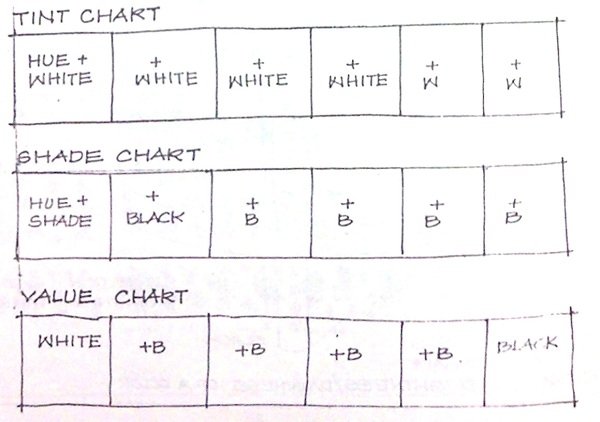
The use of Colors should be done as follows:
(Select a pallete of any 3 primary colors + white and Black)
Pallete1:
- Scarlet Lake
- Cadmium Yellow
- Cobalt Blue
Pallete2:
- Crimson
- Yellow ochre
- Pressian Blue
Pallete 3:
- Red
- Lemon Yellow
- Ultamarine blue
Instructions to be followed when mixing water colors for painting:
- Mix the colors thoroughly with water – lots of water to make it transparent.
- Transparency is diminished by the addition of white – white makes a color opaque.
- Never use a direct primary color – Use color in its hues (Primary color with addition of adjacent color).
- Use color in thin flat washes. For darker shades or intensity, apply more coats of color rather than one coat of thick color.
- Rout go over the colored area twice when it is wet unless when using a wet wet technique.
- Use the background of white as also a color.
- Any color to be applied must contain a bit of other colors in the pallete.